Farm fencing in Mildura: what this page covers
Farm fencing in Mildura and Sunraysia means, most often, a post and wire fence that holds sheep or cattle in a paddock or along a boundary. This page explains how that kind of fence is put together, the words a quote will use, which rules apply on the Victorian side and the New South Wales side of the Murray, and what to ask before you agree to a price. We are a referral service: your enquiry is passed to a local contractor, who does the work and is responsible for holding any licence or registration that applies.
The page is about stock fencing only. Fences for rabbits and kangaroos are on the exclusion page, horse paddocks on the horse and lifestyle page, and vineyard and orchard perimeters on the horticulture boundary page.
Where stock fencing is needed
The 2021 Census shows grain and sheep country on both sides of the Murray. At Ouyen, other grain growing employs 10.8 per cent of working people and grain-sheep or grain-beef cattle farming 5.5 per cent (Census QuickStats for Ouyen). In the Wentworth-Balranald region, sheep farming is 8.2 per cent (Census QuickStats for the region). In Wentworth Shire as a whole, sheep farming is 3.3 per cent, or 104 people (Census QuickStats for Wentworth Shire). Those are employment shares, not counts of paddocks or fence length, so they say where the work is, not how much fencing there is.
Local detail is on the Ouyen and the Mallee page for the Victorian side and the Wentworth Shire page for the New South Wales side.
Post and wire fencing: the parts
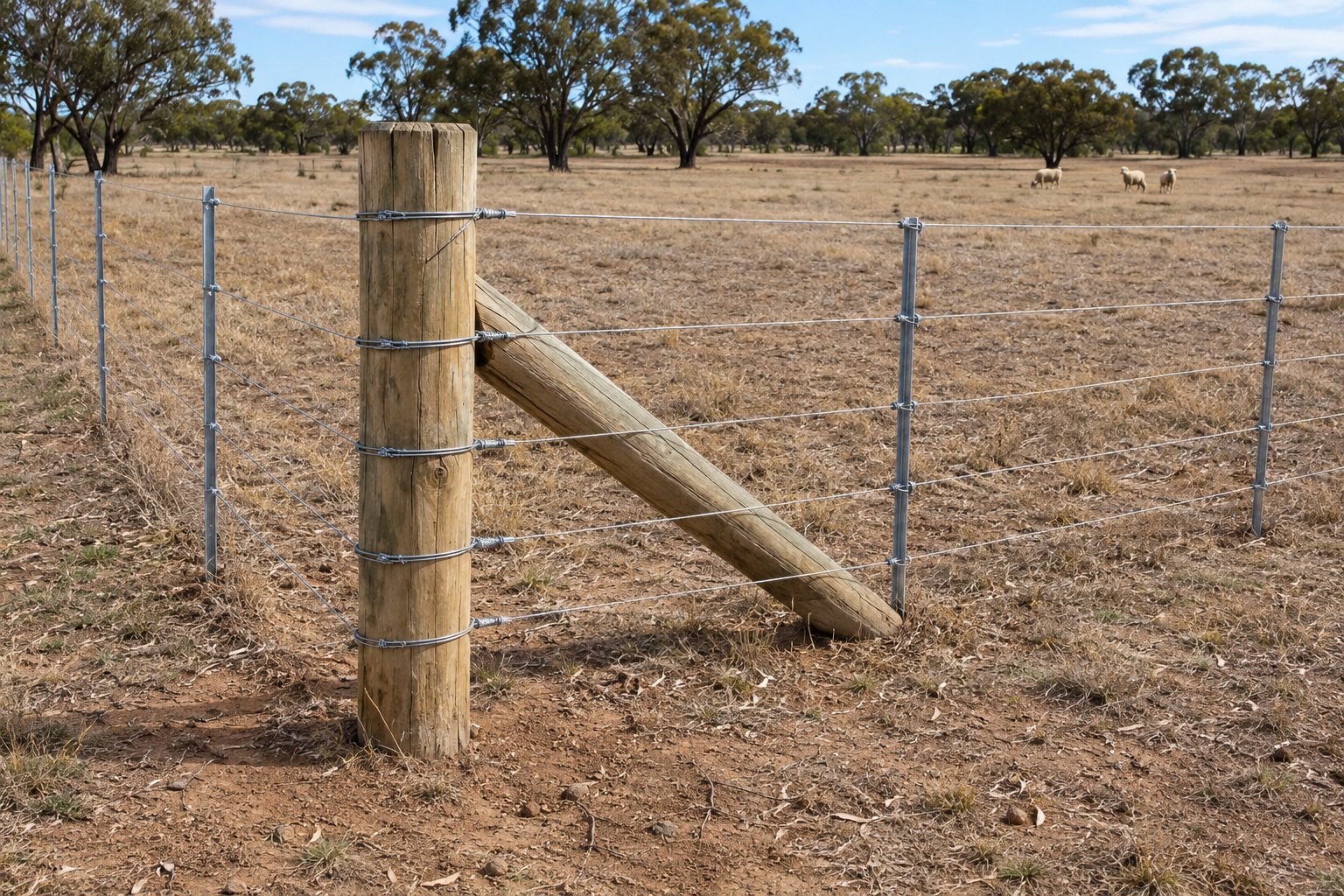
A post and wire fence keeps wire under tension between braced end posts, with smaller posts between to hold the wires spaced (an encyclopedia article, a secondary source). The same article says high-tensile wire tolerates wider post spacing and that mild steel barbed wire suits cattle. One supplier's fencing handbook (supplier fencing handbook) offers plain wire in standard or heavy galvanised and in low or high tensile, and it is the source for the parts below.
| Part | What the supplier handbook says | Ask the contractor |
|---|---|---|
| Strainer assemblies | Go at fence ends, gateways, corners, direction changes, hilltops and gully bottoms. | How many the fence needs, and where. |
| Angle stays and box assemblies | Angle stays suit firm ground. Box assemblies suit soft ground. | Which they propose for your ground, and why. |
| Suspension fences | Droppers hold the wires, and the posts sit further apart. They suit flat country. | Whether your paddock is flat enough for one. |
| Straining | Wire is strained to the manufacturer's tension, measured with a tension tool. | Whether the tension is checked and with what. |
| Post material | Treated timber is resistant to rot and termites. Steel suits high fire-risk areas. | What post type and treatment, or galvanising, is quoted. |
The Mallee soil survey describes soils from sands to clays, and in some stony soils a limestone layer near the surface. Ask the contractor what that means for your line, and see the hard ground guide. How long any of it lasts is a different question, and the lifespan page explains why this site gives no figure.
Ringlock, netting and how the sizes are written
Prefabricated wire is described by a code that reads height, then line wires, then spacing. The supplier handbook gives the example "7/90/30": seven line wires, 90 cm high, with 30 cm spacing. Netting is written the same way, for example "90/4/1.4", meaning 90 cm high, 4 cm mesh and 1.4 mm wire. A quote that says only "ringlock" has left out the information you need to compare it with another quote.
On post spacing, one supplier's FAQ (supplier FAQ) calls a star post spacing of 5 m "a compromise between cost, visual impact and strength", and says strainer posts should be driven to a minimum of 1150 mm with a backup star post at 10 to 15 degrees. That is a supplier statement about its own product, so treat it as one input, and ask the contractor what spacing and depth they will use on your ground.
Matching the fence to the stock
The fence follows the animal. Mild steel barbed wire suits cattle, according to the secondary source above, but is not advised for horses, which is why horse paddocks have their own page. For sheep we found no Sunraysia-specific design in the sources we read, so ask the contractor which fence they propose for your sheep, how many line wires, what height and why. An electric wire can be added to some fences, and the electric fence guide covers the parts and the earthing in dry sandy soil. Barbed wire should not be electrified (the supplier handbook).
Boundary fences on each side of the Murray
If the fence is on a boundary with a neighbour, the Act depends on the side of the Murray. On the Victorian side of the Murray, Justice Victoria says the law "doesn't set a height or material" and that "For rural properties, a sufficient dividing fence might be a wire and post fence" (Justice Victoria). The neighbour has 30 days from receipt to respond to a Fencing Notice. The Victorian boundary page has the rest.
On the New South Wales side of the Murray we found no rural statement. Legal Aid NSW says what is sufficient depends on the existing fence, other fences in the area, how the land on each side is used, council requirements and privacy (Legal Aid NSW). The notice must be served at least one month before an application. The New South Wales boundary page covers it. If a block runs along the river, a channel or Crown land, read the Murray page too.
What moves a stock fencing quote
The factors that matter most are the length and the terrain, access for machinery, the ground, how many strainer assemblies and gates there are, any clearing, any permits and, on a boundary, the shared items. Difficult ground with limited machinery access usually needs more manual labour and time. The cost guide goes through each factor and gives the checklist for comparing written quotes. We publish no prices.
Two other things belong in the quote conversation. Ask which licence or registration the contractor holds and check it with the regulator for the side of the Murray where the fence is, because the regulator pages we found do not say whether farm or stock fencing needs one (the licensing page has the detail). And ask how Total Fire Ban days affect the work. The Victorian documents we found, both old, restrict grinding and welding in the open on those days, so check current CFA rules, and on the New South Wales side of the Murray ask the RFS.
What this page cannot do
It cannot design a fence for your paddock, because the right spacing, height and wire depend on your stock, your ground and your fence line. It cannot give a price or a lifespan, and it cannot say what licence or registration a contractor needs, because the regulator pages we found do not say for farm and stock fencing. It cannot approve a permit or settle a neighbour dispute. The figures on this page come from one supplier's handbook, one supplier's FAQ and a secondary source, and each should be read that way. Ask the contractor, the council and the regulator for your block.
Check the current rules before you rely on this
This page describes how post and wire stock fences are built and what applies to a farm boundary fence on each side of the Murray. It describes the rules in general terms as they stood in November 2026. Standards, forms, thresholds and fines change.
The authoritative sources are Justice Victoria, fences: your rights and obligations, Legal Aid NSW, fences: your rights and obligations, NSW Government, fencing work (Building Commission NSW) and Consumer Affairs Victoria, becoming a registered building practitioner. Where anything here differs from those sources, they are right and we are not.
We are not fencing contractors, builders, regulators or lawyers. For what applies to your fence, ask the contractor which licence or registration they hold, then ask the regulator for the side of the Murray where the fence is: Building Commission NSW (13 27 00) for New South Wales, the Building and Plumbing Commission for Victoria.
Accurate at the time of writing, November 2026. Always check the source before relying on it.