Fencing in sandy soil and limestone: what the soil survey says
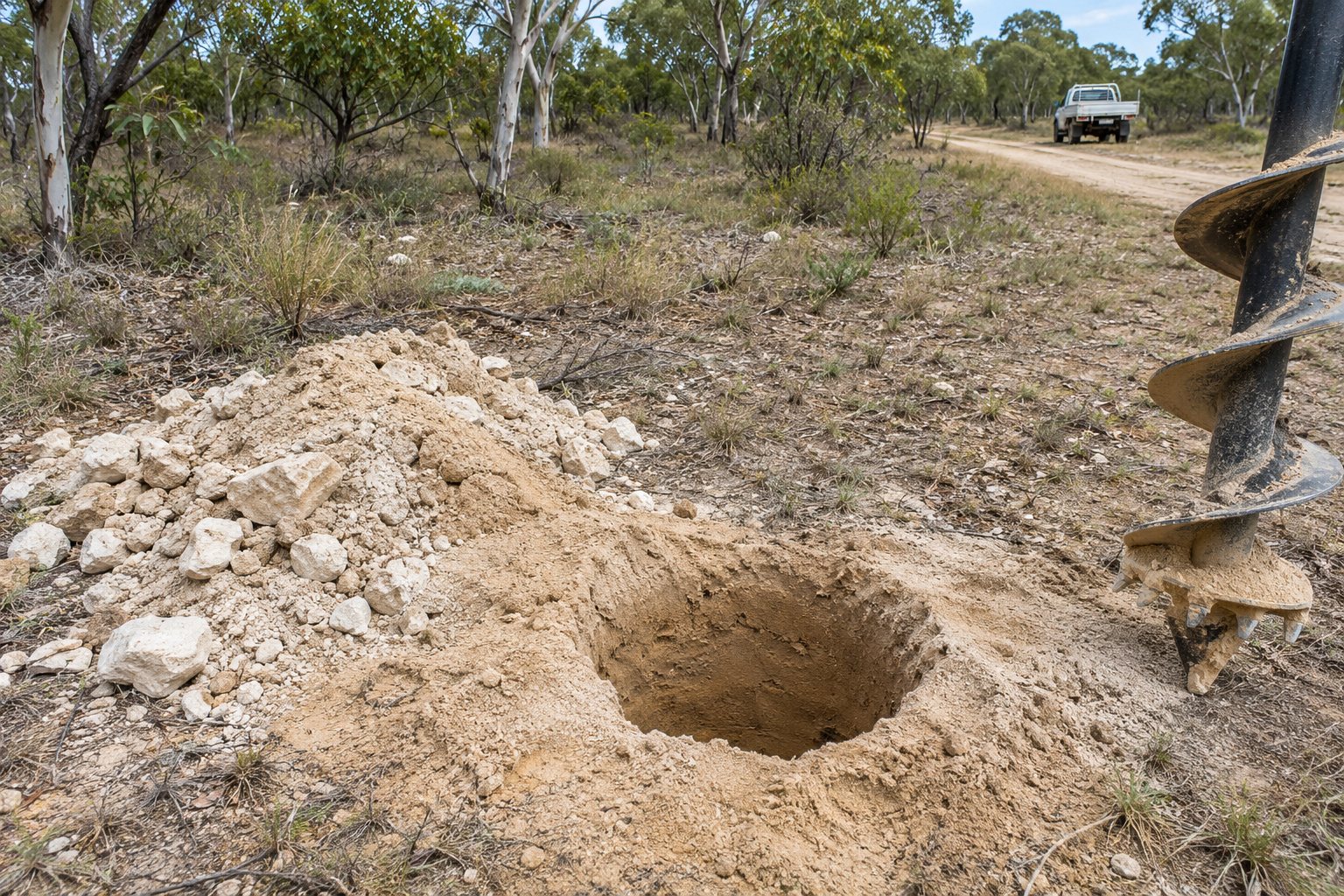
The ground around Mildura is not one thing. The Victorian soil survey for the Mallee describes soils "from those dominated by sands to those that are clayey throughout", with lime common in the subsoil and, in stony soils, a solid limestone layer within 30 cm of the surface (Mallee Calcarosols). That is what the survey offers a fence owner: a description of the ground. It does not address digging or post installation, so this page cannot say how hard any hole will be. It can say what the survey describes, and what to ask a contractor about rock and sand before you accept a quote.
The soil descriptions, and the question each one raises
Read the survey and the questions together. The left column is what the survey says, the middle column is where, and the right column is a question for the contractor, because the survey stops at the soil.
| What the survey describes | Where and how | A question for the contractor |
|---|---|---|
| Sands | Occur mainly on east-west dunes and are very prone to wind erosion. Light-textured soils dominate the north. | How will posts and strainer assemblies be set in loose ground? |
| Heavier soils | Heavy-textured soils dominate the south, and they can become hardsetting. | Does the quote allow for slower digging in hard-setting ground? |
| Lime in the subsoil | Common, sometimes in nodules or as blocks. | Has the contractor met lime blocks on similar ground, and how are they handled? |
| Stony soils with a limestone layer | A solid limestone layer within 30 cm of the surface and a metre or more thick. | Does the quote allow for drilling, and how is rock charged? |
Not every block has every layer. The survey describes the Mallee Calcarosols as a group, from sandy to clayey, so a description of the group is not a description of your fence line. The most useful thing you can do is tell the contractor what you know: any holes already dug, any rubble at the surface, any patches that blow or set hard.
What the survey does not say
The survey has nothing on post depth, drilling, equipment or cost. We found no neutral source that answers those questions, so we do not say how deep posts go, whether contractors drill, or what rock adds to a job. That is the contractor's knowledge, and it should appear in writing in the quote. The cost and quote guide shows where rock drilling sits among the other items a quote should name.
Strainer assemblies in firm ground and soft ground
One technical point does bear on the ground. One supplier's fencing handbook places strainer assemblies at fence ends, gateways, corners, direction changes, hilltops and gully bottoms. It says angle stays suit firm ground and box assemblies suit soft ground. It does not say which kind of Mildura-area ground counts as firm or soft. Ask the contractor which assembly they propose for each end and why, and ask what changes if the ground turns out different from what they expected on the day. The farm and stock fencing page covers the parts of a post and wire fence.
Questions about rock and sand for the quote
- Is drilling allowed for? If so, for how many holes or how much of the line.
- How is rock charged? If rock turns up part-way along the line, ask how the extra is calculated and how the change is agreed in writing.
- Which end assemblies? Angle stays or box assemblies at each end, and why.
- What about loose sand? How the contractor proposes to set posts where the ground is loose.
- Is the fence electric? Dry sandy soil changes earthing, which is a separate question; see the electric fence guide.
- When will the work happen? Heat, fire restrictions and harvest can all move the date; the seasons guide covers them.
Digging safely
A university safe operating procedure for fencing (University of New England procedure), which is a procedure and not a regulator's rule, lists several points that apply when holes are being dug and posts driven. Call Dial Before You Dig on 1100 before digging strainer post holes. Use a post holder rather than your hands. Keep people clear of the swing path of manual post drivers. Take care with tractor stability when a three-point linkage post driver is used. Ask the contractor how they handle each point on your block. For the Mallee grain and sheep country, the Ouyen and the Mallee page has the local facts.
When you are ready, send your town, a photo of the fence line and anything you know about the ground, and the enquiry goes to a local contractor.
What this guide cannot do
This guide cannot tell you what is under your fence line. The soil survey describes a group of soils across the Mallee, not your block, and it says nothing about digging or posts. We cannot say whether you will meet limestone, how deep it is, or what drilling it would take. We are a referral service: we pass your enquiry to local contractors, who see the ground and decide how to build on it, and who hold any licence or registration that applies. The safety points come from a university procedure and are not a substitute for a contractor's own site assessment.
Check the current rules before you rely on this
This page describes what the soil survey says about sand, lime and limestone around Mildura and the questions to ask a contractor about rock and sand. It describes the rules in general terms as they stood in November 2026. Standards, forms, thresholds and fines change.
The authoritative sources are Victorian Resources Online, Mallee Calcarosols, Rural supplier's fencing handbook (undated; supplier guide, no heights, spacings or costs) and University of New England, safe operating procedure 09: fencing (28 March 2018; a university procedure, not a regulator). Where anything here differs from those sources, they are right and we are not.
We are not fencing contractors, builders, regulators or lawyers. For what applies to your fence, ask the contractor which licence or registration they hold, then ask the regulator for the side of the Murray where the fence is: Building Commission NSW (13 27 00) for New South Wales, the Building and Plumbing Commission for Victoria.
Accurate at the time of writing, November 2026. Always check the source before relying on it.